Best of Joe Hisaishi: Top Songs and Albums Ranked
Best of Joe Hisaishi: Top Songs and Albums Ranked
TL;DR:
- Joe Hisaishi is a prominent film composer known for emotionally direct orchestral music in Studio Ghibli films. His most popular compositions, like “Merry-Go-Round of Life” and “The Name of Life,” are accessible and emotionally impactful. His minimalist style emphasizes melody and warm orchestration, expanding into concert works outside films.
Joe Hisaishi is the defining film composer of the Studio Ghibli era, responsible for some of the most emotionally direct orchestral music ever written for cinema. His scores for films like Spirited Away, My Neighbor Totoro, and Howl’s Moving Castle have crossed from soundtrack status into the concert hall repertoire. The best of Joe Hisaishi represents a body of work that balances melodic simplicity with genuine emotional power, a combination that few composers in any genre have matched. For film and music enthusiasts in California and beyond, understanding which works to start with makes the difference between a casual listen and a lifelong obsession.
What are Joe Hisaishi’s most popular and iconic compositions?
Streaming numbers tell a clear story about which pieces have connected most deeply with listeners. “Merry-Go-Round of Life” from Howl’s Moving Castle is Hisaishi’s top-performing track on Spotify with over 160.5 million streams as of june 2026. That figure places it well ahead of nearly every other film score piece in the Japanese classical catalog.
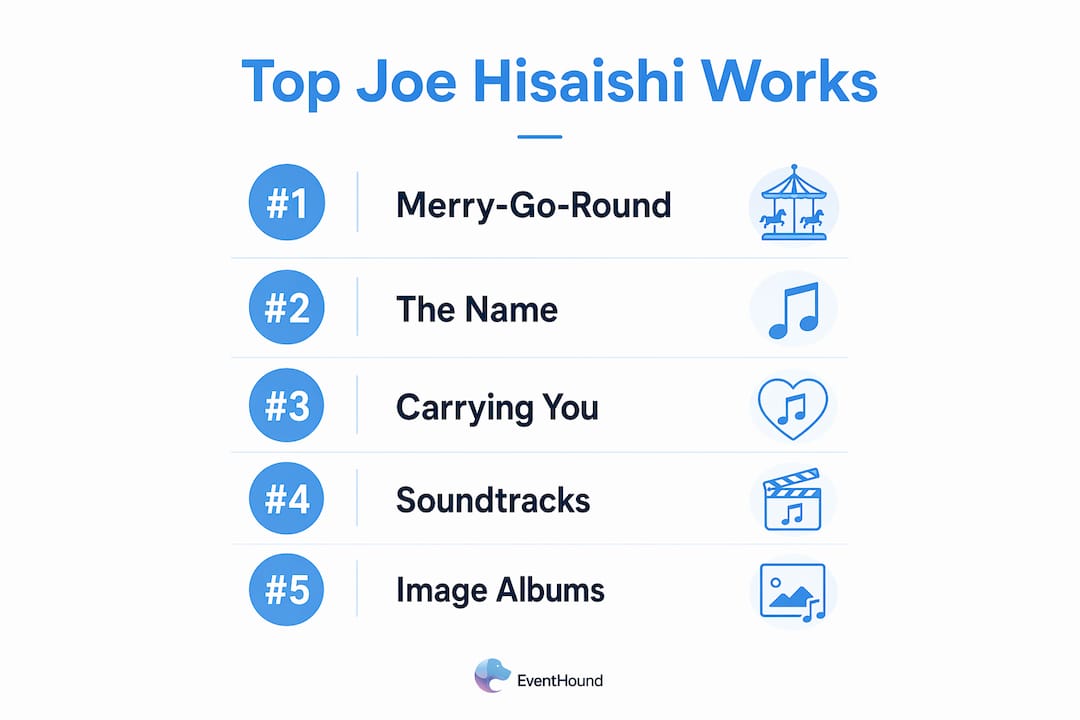
The gap between first and second is significant but not crushing. “The Name of Life” from Spirited Away follows with 112.3 million streams, and the Nausicaä of the Valley of the Wind theme rounds out the top three at 93.7 million. Those three tracks alone account for a massive share of his total streaming presence, which tells you exactly where to start if you are new to his catalog.
What makes these pieces work is not complexity. “Merry-Go-Round of Life” is built on a waltz structure that a beginner pianist can learn in a week, yet it carries a weight that professional orchestras perform with full seriousness. “The Name of Life” uses a slow, ascending melody that mirrors the feeling of a child discovering something vast and unfamiliar. Both tracks succeed because the emotional content is immediate and unambiguous.
| Track | Film | Spotify Streams |
|---|---|---|
| Merry-Go-Round of Life | Howl’s Moving Castle | 160.5M+ |
| The Name of Life | Spirited Away | 112.3M |
| Nausicaä of the Valley of the Wind | Nausicaä of the Valley of the Wind | 93.7M |
Pro Tip: Start with “Merry-Go-Round of Life” in a full orchestral recording rather than a solo piano version. The string arrangement reveals layers of harmonic color that the piano reduction cannot fully capture.
How does Joe Hisaishi’s musical style define the best of his work?
Hisaishi’s minimalist yet emotive style is the foundation of everything that makes his music work. He does not rely on dense counterpoint or complex harmonic progressions. Instead, he writes melodies that carry the full emotional weight of a scene on their own, then supports them with warm, acoustic orchestration that never competes for attention.
His core philosophy is direct. Hisaishi believes that melody must transcend technological trends, and his track record proves the point. Scores he wrote in the 1980s for early Ghibli films sound as fresh today as they did on release. That durability comes from choosing honest emotional expression over production fashions.
His approach to specific emotional states is worth examining closely:
- Wonder: Hisaishi uses ascending melodic lines and open harmonies, often in a major key, to create a sense of discovery without sentimentality.
- Fear or tension: He shifts to minor modes and sparse textures, letting silence do as much work as sound.
- Nostalgia: Slow tempos, warm string pads, and simple repeated motifs create a feeling of memory without becoming saccharine.
- Joy: Rhythmic energy and bright woodwind colors lift the melody without overwhelming it.
“Carrying You” from Castle in the Sky is the clearest example of his philosophy in action. The track was created under tight deadlines with a deliberate focus on emotional clarity and acoustic warmth. The result is a piece that sounds effortless precisely because the composer made hard choices about what to leave out.
Which Joe Hisaishi albums and collections are essential for enthusiasts?

The right starting point depends on how deep you want to go. For listeners who want a single disc that covers the full range of his career, “The Best Collection” CD is the most direct answer. Hisaishi curated and remastered it himself, drawing from eight albums and including tracks from Nausicaä and Spirited Away, plus a vocal performance by his daughter Mai. That personal involvement makes it more than a standard greatest hits package.
For collectors who want the complete picture, the Miyazaki Hayao & Hisaishi Joe 13-disc box set is the definitive audio document. It covers the full Ghibli collaboration in original soundtrack form. The investment is significant, but no other release matches its depth or completeness.
A third category worth knowing about is the Image Album. These are early production recordings that Hisaishi created before the final film scores were completed. They establish tone and themes in arrangements that sometimes differ substantially from what ended up in the finished films. Superfans prize them because they reveal how his compositional ideas developed across a production.
For pianists and readers who want to play his music, composer-approved piano arrangements like Studio Ghibli Best Stories: Original Edition provide a direct path into the material. At around $39.95, that collection offers a curated set of his most beloved themes in versions he has personally sanctioned.
| Format | Best For | Investment Level |
|---|---|---|
| The Best Collection CD | New listeners, broad overview | Low |
| 13-disc box set | Collectors, complete Ghibli catalog | High |
| Image Albums | Superfans, compositional history | Medium |
| Piano arrangement books | Players, hands-on engagement | Low to medium |
Pro Tip: If you are new to his catalog, buy “The Best Collection” first. If you already own three or more individual soundtracks, the box set becomes the logical next step rather than a luxury.
How has Joe Hisaishi’s music evolved beyond film scores?
Hisaishi’s career does not stop at film music. His concert work forms a genuine dialogue between film scoring and modern classical music, and that dialogue has expanded his artistic reach well beyond cinema. Critics and programmers have compared his dual role to the relationship between John Williams and Steven Spielberg, where film work and concert commissions feed each other rather than compete.
His orchestral suites are the clearest expression of this evolution. The Spirited Away suite is a 25-minute single movement drawn from 10 scenes of the film, reordered to tell the story as a linear concert narrative. That reordering is not a simple medley. Hisaishi restructures the emotional arc so that the music works as a standalone piece for listeners who have never seen the film.
His concert commissions push further into modern classical territory:
- Concerto for Orchestra represents his most ambitious non-film work, written for full symphony orchestra without any film reference point.
- Chamber works and solo piano pieces have appeared alongside his film arrangements in major concert programs.
- He has conducted his own works with orchestras in Japan, Europe, and North America, maintaining direct artistic control over how the music is performed.
This evolution matters for enthusiasts because it means the catalog keeps growing in genuinely new directions. Hisaishi is not simply repackaging old film themes. He is using the concert hall to ask what his musical language sounds like when it is not serving a visual narrative. The answer, based on the reception of works like Concerto for Orchestra, is that it holds up on its own terms.
Key Takeaways
Joe Hisaishi’s greatest work succeeds because it prioritizes emotional directness over complexity, a philosophy that makes his music equally powerful in film, concert, and solo performance contexts.
| Point | Details |
|---|---|
| Start with streaming leaders | “Merry-Go-Round of Life” and “The Name of Life” are the clearest entry points into his catalog. |
| Style over complexity | His minimalist, acoustic approach gives his music durability that production-heavy scores rarely achieve. |
| Choose albums by depth | “The Best Collection” suits new listeners; the 13-disc box set suits serious collectors. |
| Concert music expands the catalog | Orchestral suites and commissions like Concerto for Orchestra show his range beyond film. |
| Image Albums reward deep listeners | Early production recordings reveal how his themes developed before final scores were locked. |
Why Joe Hisaishi’s music is impossible to outgrow
I have spent years listening to film scores from every era and tradition, and Hisaishi occupies a category that very few composers reach. His music does not age because it was never fashionable to begin with. He made a deliberate choice, early in his career, to write melodies that could stand without production support. That choice looked almost conservative in the synthesizer-heavy 1980s. Thirty years later, it looks like the smartest long-term decision in the history of film music.
What surprises most listeners who go deeper into his catalog is how technically demanding his music is to perform well. The simplicity is deceptive. A melody with no harmonic complexity to hide behind requires a performer to bring everything to the phrasing and dynamics. I have heard professional pianists struggle with “Merry-Go-Round of Life” precisely because there is nowhere to hide. That is the mark of genuinely sophisticated writing.
The other thing worth saying is that his concert reinterpretations are not nostalgia products. When Hisaishi restructures the Spirited Away suite for the concert hall, he is doing compositional work, not just programming crowd-pleasers. California audiences who have caught his touring concerts know exactly what I mean. The experience is closer to a contemporary classical concert than a film music retrospective.
— Gregory
Find Joe Hisaishi events near you with Eventhound
Candlelight concerts featuring Hisaishi’s music have become a fixture in California’s live music scene, with intimate venues programming his Ghibli themes alongside other film score favorites. If you want to experience his music performed live, finding the right event at the right time is the challenge.

Eventhound makes that search simple. The platform uses AI to match your location and preferences with live music events happening nearby, including orchestral nights, Candlelight series, and film score concerts. Whether you are in Los Angeles, San Francisco, or anywhere in between, Eventhound AI delivers personalized recommendations so you spend less time searching and more time listening.
FAQ
What is Joe Hisaishi’s most streamed song?
“Merry-Go-Round of Life” from Howl’s Moving Castle is his most streamed track, with over 160.5 million Spotify streams as of june 2026.
Which Joe Hisaishi album should a new listener buy first?
“The Best Collection” CD is the best starting point. Hisaishi curated and remastered it himself, drawing from eight albums to give a broad overview of his career.
Does Joe Hisaishi compose music outside of film scores?
Yes. He writes orchestral suites, chamber works, and concert commissions like Concerto for Orchestra that exist entirely outside any film context.
What makes Joe Hisaishi’s musical style distinctive?
His style is minimalist and acoustic, prioritizing clear melodies and warm orchestration over harmonic complexity. That simplicity is what gives his music its emotional directness and long-term durability.
Are Joe Hisaishi’s Image Albums worth collecting?
Image Albums are early production recordings that differ from final film scores. They are not essential for new listeners, but they offer serious fans a unique look at how his themes developed before the finished films were completed.